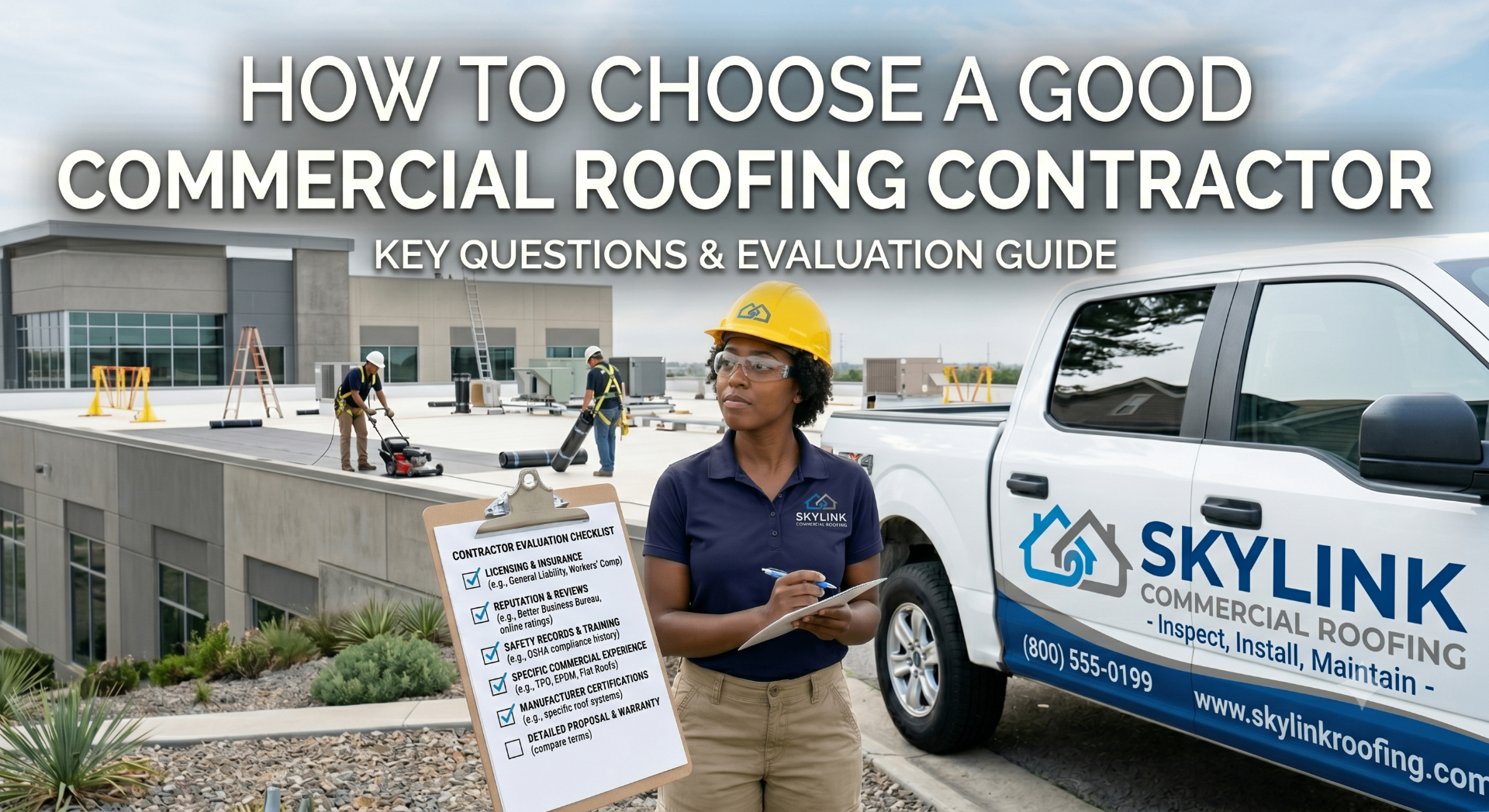
A commercial roof is one of the most expensive assets on your building — and the wrong contractor can turn a routine re-roof into years of leaks, voided warranties and budget overruns. This guide gives you a practical evaluation framework: what to verify, what to ask, and what red flags should end the conversation immediately.
What you'll learn
- Verify licensing and insurance
- Check reputation and references
- Confirm safety records and training
- Match commercial roofing system experience
- Look for manufacturer certifications
- Compare proposals and warranties
- Key questions to ask before signing
- Red flags that should end the bid
1. Verify licensing and insurance
This is non-negotiable. In Oregon, any contractor working on a commercial roof must be licensed by the Construction Contractors Board (CCB). Verify the license number on the CCB website — not on the contractor's brochure.
- General liability: $1M minimum, $2M is standard for commercial work.
- Workers' compensation: required for every employee on your roof. If they're injured and the contractor isn't covered, you can be liable.
- Commercial auto: for trucks, cranes and material delivery.
Ask for current certificates of insurance (COI) sent directly from the insurer — not a PDF the contractor emails you.
2. Check reputation and references
Online ratings tell part of the story; references tell the rest.
- Look up the company on the Better Business Bureau, Google, and industry-specific sites.
- Ask for at least three commercial references from the last 24 months — not residential.
- Call the references. Ask: did they finish on time? Did the final invoice match the proposal? How did they handle the first leak call?
3. Confirm safety records and training
Roofing is one of the most dangerous trades in America. A contractor with a poor safety record will eventually cost you in delays, lawsuits, or insurance hikes.
- Ask for their OSHA 300 logs for the past three years.
- Request their Experience Modification Rate (EMR) — under 1.0 is good, under 0.85 is excellent.
- Confirm crews have OSHA 10 or OSHA 30 training and fall-protection certification.
4. Match commercial roofing system experience
Commercial roofs aren't shingles. The contractor must have hands-on experience with your roof system:
- TPO — heat-welded seams, single-ply membrane. Most common new install in the PNW.
- EPDM — rubber membrane, glued or mechanically fastened.
- PVC — chemical-resistant, common over restaurants and warehouses.
- Modified bitumen / built-up — older but still appropriate for some buildings.
- Metal standing seam — long lifespan, requires specialized crews.
Ask how many square feet of your specific system they've installed in the last 12 months. A great TPO contractor may be the wrong choice for a metal re-roof.
5. Look for manufacturer certifications
Major manufacturers (GAF, Carlisle, Firestone, Johns Manville, Sika Sarnafil) certify contractors who meet training, financial, and quality standards. Certifications unlock the strongest warranties — including NDL (No Dollar Limit) warranties that cover labor and materials for 20–30 years.
An uncertified contractor cannot give you an NDL warranty, period. If long-term coverage matters (it should), require a manufacturer-certified installer.
6. Compare proposals and warranties
Get at least three written proposals. Watch for hidden cost differences — a "cheap" bid is often missing critical line items.
A complete commercial roofing proposal should include:
- Detailed scope: tear-off vs. recover, insulation R-value, membrane thickness (e.g., 60-mil vs. 80-mil TPO).
- Flashings, edge metal, drains, curbs, penetrations — itemized.
- Manufacturer and product names — not generic terms like "rubber roof."
- Warranty type and duration: workmanship warranty (from contractor, typically 2–10 years) and material/system warranty (from manufacturer, typically 15–30 years).
- Disposal, permits, and clean-up costs.
- Payment schedule tied to milestones — never pay more than 10–20% upfront.
7. Key questions to ask before signing
- How long have you been in business under this exact legal name?
- Are you certified by the manufacturer of the system you're proposing?
- Who will be the on-site foreman, and how many of your jobs has he run this year?
- Will you pull the permit, or are you asking me to?
- What's your EMR and most recent OSHA recordable?
- How do you handle change orders and unexpected deck damage?
- What's your warranty response time for a leak call?
- Can I see a sample of the actual contract before I commit?
Find vetted Oregon roofing contractors
Browse licensed commercial roofing contractors serving Portland, Salem, Eugene and Bend.
Browse roofing contractors →8. Red flags that should end the bid
- Won't provide a CCB license number or insurance certificates.
- Demands a large upfront deposit (more than 20%).
- Pressure tactics: "this price is only good today."
- Door-to-door storm chasers with out-of-state plates after a wind event.
- Vague proposals with no manufacturer or product names.
- No physical office address — only a PO box and a cell phone.
- Bid significantly lower than the others (usually means tear-off, insulation, or flashings were skipped).
Final thoughts
The best commercial roofing contractor isn't the cheapest — it's the one who shows up with a CCB license, a manufacturer certification, an EMR under 1.0, and a written proposal that names every product going on your building. Spend an extra week on the evaluation. It's cheaper than a re-roof three years from now.
A commercial roof is a 25-year decision. Pick the contractor like you mean it.